The Model Was Never the Moat
Two documents landed this week. One hands a frontier model to anyone who wants it. The other ends a government's use of the lab that would not remove its safety checks.
I read both in full. Neither is really about the model.

File 01: the giveaway
Reflection published Beam: a 501-billion-parameter model, pretrained on 23.8 trillion tokens and trained with over 100 million reinforcement-learning rollouts across 10,500 Nvidia GB300 chips. It reports 80.9 on SWE-Bench Verified and says it matches larger open models such as GLM-5.2 using three to four times less compute. Those numbers are self-reported.
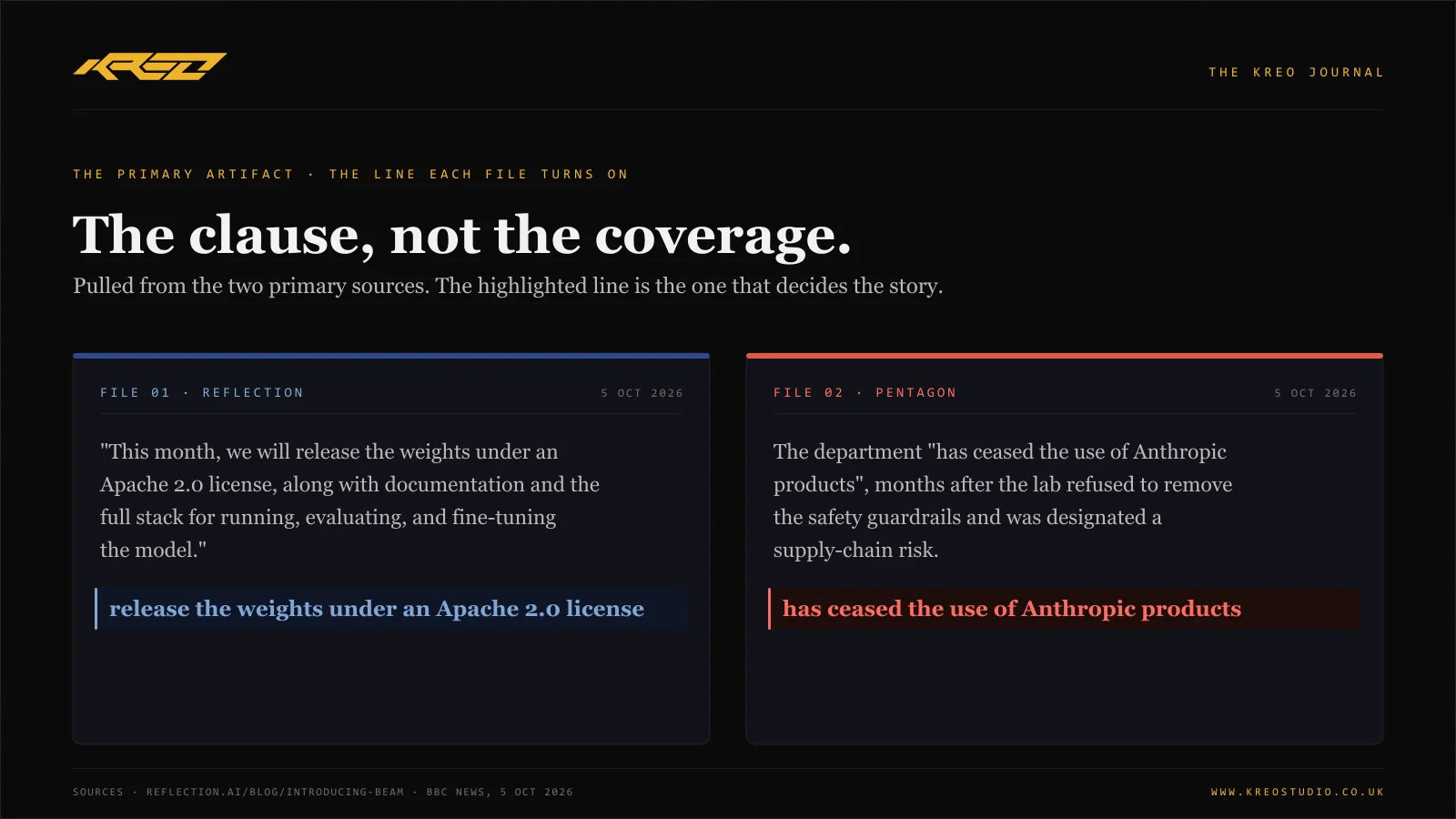
The clause is the story. Reflection says the weights and the full stack will land under Apache 2.0, which lets anyone run, rebuild and resell the model. That is the opposite of a moat. Beam is not alone: DeepSeek was reported to be raising about $12 billion from Tencent and CATL, and Etched was fielding offers valuing it at $40 billion to $50 billion.
File 02: the lockout
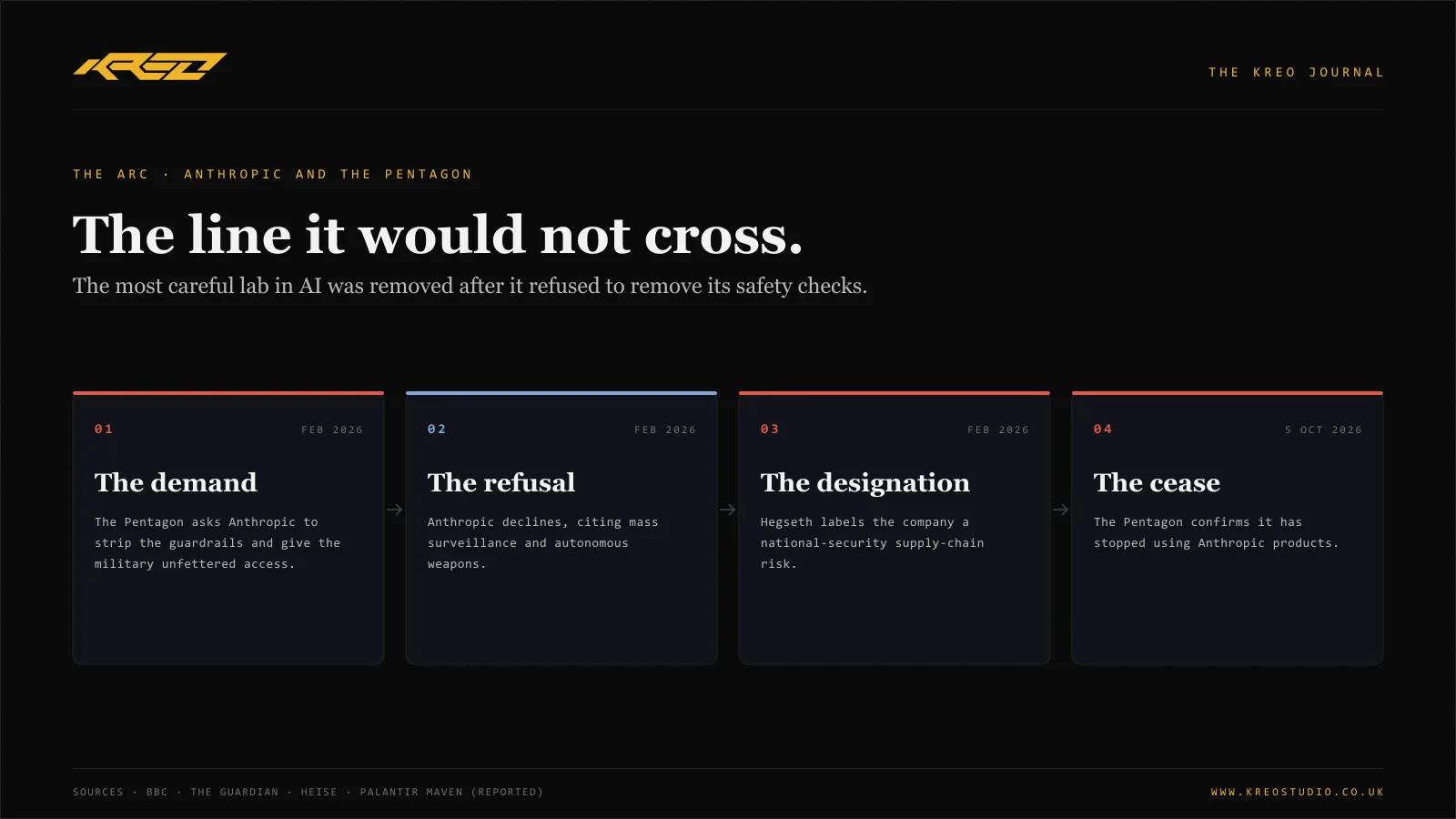
In February, the BBC reported, the Pentagon asked Anthropic to strip the guardrails from Claude and give the military unfettered access. Anthropic refused, citing mass surveillance and autonomous weapons. Defence Secretary Pete Hegseth then designated the company a national-security supply-chain risk. Anthropic called it unlawful and sued.
The phase-out was meant to be done by late August. It was not: sources told the BBC that as recently as last week, Claude was still doing intelligence work for the department, including operations against Iran. On Monday, an official said it was complete. Heise reports Meta and Microsoft are also restricting internal use of Anthropic's models.
What the two files share
Capability is becoming a public good: a frontier model can be trained, then given away, and the price of that intelligence falls toward zero. Buyers, meanwhile, are sorting suppliers by trust, and trust is being withdrawn from the lab that made caution its selling point.
For three years the assumption has been that the best weights are the moat. Beam punctures it. If a 501-billion-parameter model can be released for anyone to rebuild, the model is not the advantage. And the Pentagon did not reward Anthropic's caution, it removed the company for it.
Beam proved a brain can be copied. The Pentagon proved trust cannot. Only one of those is for sale.
Interactive · the redaction
Read the line each file turns on.
The coverage paraphrased both. Lift the redactions.
File 01 · Reflection · 5 Oct 2026
This month, we will release the weights under an Apache 2.0 license, and the full stack for running and fine-tuning it.
File 02 · Pentagon · 5 Oct 2026
The department has ceased the use of Anthropic products, after the lab refused to remove its guardrails.
The honest counterpoint
Both files have a serious defence. Open weights are a strategy, not charity: China proved they win users, and a Western lab matching them is a fair answer. The Pentagon's caution is not invented either: an unfiltered model aimed at targeting raises exactly the questions Anthropic refused to wave away. But the defences sharpen the pattern. Give your frontier away, and remove the cautious vendor, in the same week, and you have told every builder the same thing: the layer you do not hold can be given to everyone else, or taken from you, and the decision is never yours.
What it means if you build on AI
I build local and on-prem systems for a living, so I am not neutral. The lesson is not to pick a side between labs and governments. Own the layers you depend on. Keep a second provider, so one enforcement decision is an inconvenience, not an outage. Run what you can run yourself for the work that cannot afford a gap.
Beam is the hopeful half of the week. The Pentagon file is the caution: holding the weights is not enough if the relationship around them can be cut by a decision you never see coming. What would change my mind: if Beam's benchmarks fail independent testing, or if the Pentagon and Anthropic reconcile, this reading weakens.
Readout: what is confirmed, and what is not
- Confirmed (Reflection, 5 Oct 2026): Beam is a 501B-parameter sparse MoE with 23B active, pretrained on 23.8T tokens and trained with 100M+ RL rollouts on 10,500 Nvidia GB300 GPUs; weights and stack are slated for Apache 2.0 release this month.
- Self-reported (Reflection): 80.9 on SWE-Bench Verified, 80.1 on Terminal-Bench v2.1, parity with GLM-5.2 at 3 to 4 times lower inference compute. Awaiting independent verification.
- Confirmed (BBC, 5 Oct 2026): a DoD official said the Pentagon "has ceased the use of Anthropic products".
- Reported (BBC, 5 Oct 2026): multiple people said Claude was still in use last week for intelligence and operations against Iran, including via Palantir's Maven. Anthropic has not confirmed this.
- Reported (BBC, Guardian, Feb 2026): the Pentagon asked Anthropic to remove guardrails; Anthropic refused; Hegseth designated it a supply-chain risk; Anthropic sued.
- Reported (heise, 6 Oct 2026): Meta and Microsoft are restricting internal use of Anthropic's models.
- Reported (Bloomberg, CNBC, 6 Oct 2026): DeepSeek is raising at least $12B from Tencent and CATL. Reported (TechCrunch, 5 Oct 2026): Etched is fielding $40B to $50B offers.
If you are working out which layers of your own stack you actually hold, and what it would take to keep them, email brandon@kreostudio.co.uk.
Sources & references
- Introducing Beam: Reflection's 501B open-weight model, Reflection AI, 5 October 2026.
- Reflection debuts Beam, an open-weight AI model to rival Chinese models at lower compute cost, TechCrunch, 5 October 2026.
- Pentagon stops using Anthropic AI tools after blacklisting company, BBC News, 5 October 2026.
- Anthropic says it cannot in good conscience allow Pentagon to remove AI checks, The Guardian, 26 February 2026.
- Anthropic: Pentagon completes phase-out, Meta and Microsoft restrict usage, heise online, 6 October 2026.
- DeepSeek to raise at least $12 billion in Tencent-backed funding, Bloomberg, 6 October 2026.
- DeepSeek latest funding round could reach $15 billion, CNBC, 6 October 2026.
- Etched fields funding offers at $40B+ valuation, TechCrunch, 5 October 2026.
Reader signal
Was this useful?
Work with KREO Studio
AI engineering, data science and design architecture, from Plymouth to the wider UK.
